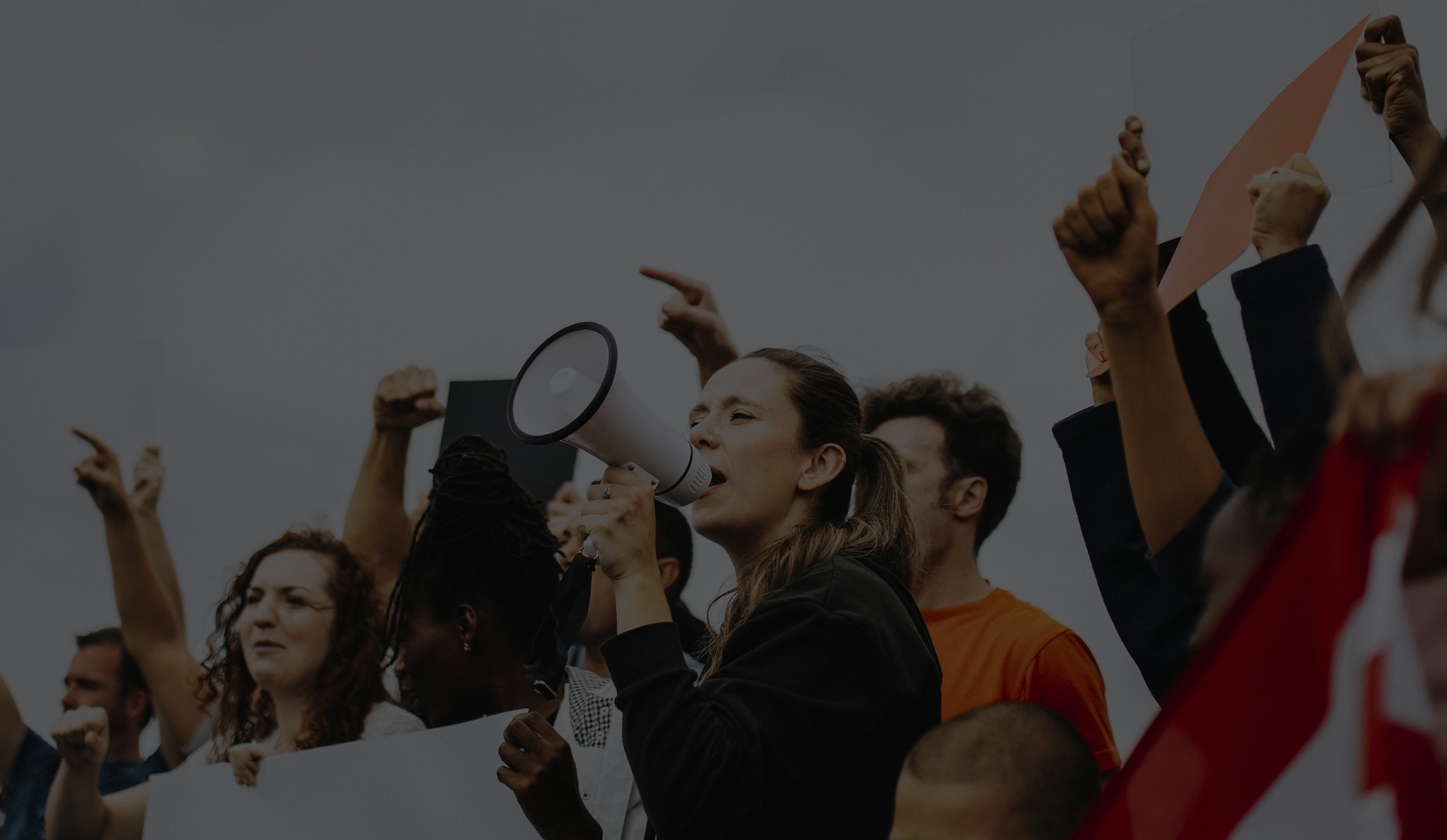
Movements are the tool for meaningful change in the U.S.. We’re creating a growing army of doers who say we want change when it comes to our psychological safety at work. Take action. Let’s move the needle on psychologically safer workplaces.
spread the word
through #EndWorkplaceAbuse, we aim to expose how workplace abuse (bullying and mobbing) works.
Our goal is for workers to join together to spread the word and urge legislators to pass protections for workers against workplace psychological abuse to:
Fight for workplace psychological safety.
Take back their voices.
We speak out together to legislators in states with active bills, especially at public hearings. We’ll advocate together state by state. Strength in numbers is a winning strategy. When there are virtual hearings and direct actions you can take in a state, we’ll let you know so you can virtually testify (in under three minutes) or share your story or talking points with decision-makers. Sign the petition to get notified of future actions.
HOW to spread the word
- Urgent action. Take urgent action to pressure lawmakers to pass the Workplace Psychological Safety Act.
- Share handouts. Print the handouts below to give to people at events.
Overview: English | Spanish | Haitian Creole
Fact sheet about women of color
Fact sheet about medical harms - Post flyers. Teachers, nurses, government workers, and workers in the non-profit sector are the most likely to get abused at work, but abuse can happen anywhere. Get flyers below printed and post them around cities and towns (subject to ordinances around flyer posting), schools, hospitals, state executive offices, and employers known to abuse workers. Take photos of flyers you post for social media and use the hashtags above and the name of your city or state. Post this flyer in local cities, especially outside toxic workplaces. You can get 200 copies for $20 plus shipping at Best Value Copy.
English | Spanish | NYC (various languages) - Share social media posts. Copy and paste the suggested social media posts or develop your own customized posts to share out the content. Add the #EndWorkplaceAbuse, #HoldEmployersAccountable, and #StopBullyingandMobbing hashtags to your social media posts and engage with us via your personal or organizational accounts. If you’re comfortable, share your story using our hashtags. Follow us on social media using the links above and share, like, and/or comment.
- Share business cards. Get these business cards printed and pass them out to people when you talk about the bill.
Landscape: Front | Back
Portrait: Front | Back - Join the private Facebook group.
- Sign our petition.
- Sign and share the Change.org petition.
- Share your story to share with a reporter.
- Follow us on social media using the links at the top of this page (scroll all the way up).
HOW TO JOIN EFFORTS IN YOUR STATE
Advocates from across the U.S. are working to get legislation introduced and passed in their states:
If your state is dark purple in the map below, there’s an opportunity to introduce the bill in your state.
If your state is light purple in the map below, you can join state efforts to introduce and pass the bill.
If your state is yellow in the the map below, you can reach out to your state legislators to encourage them to pass the bill.
State and city chapter pages:
Indiana
Massachusetts
New Jersey
Washington, DC
HOW TO LOBBY IF THERE’S AN ACTIVE BILL IN YOUR STATE
Legislators care most about what their constituents want so they can get re-elected. But not all communication is equally effective. The more effort is required of you and the more disruptive it is, the more your state legislators will take notice (especially if you can show you have organizing power to get someone else elected).
Asking your state legislators for change is simple. It involves telling your story (optional), communicating the problem, and outlining the Workplace Psychological Safety Act as the solution.
Here are the actions you can take in order of effectiveness. Using multiple methods is THE most effective way to reach your state legislators and put the issue on your legislators’ radar among the hundreds of other bills introduced each legislative session.
- Meet as a group or individually in person or over Zoom. This action requires the most effort and shows the most organizing power if you bring a group. Bring handouts to help explain the bill. You can also share your story, sticking to the facts: In what industry did you work? What did you do? How did the bullying begin? What tactics were used? How’d it escalate? How did you feel? How did your employer react (or not react)? What was the impact on you? What was the impact on the organization? Why do you want workplace anti-abuse legislation to pass?
- Call and ask them to sign onto the bill. Tell whoever answers the phone “Hi! My name is (YOUR NAME). I live in (NAME OF YOUR TOWN). I’m calling to ask (NAME OF THE LEGISLATOR) to sign onto (BILL NUMBER), the Workplace Psychological Safety Act.” They may ask you your address.
- Email a custom message. Follow the quick and simple steps in the action, then replace the email with your own reasons for wanting the bill to pass.
PRINT CENTER
large quantities
For large quantities, use our print center:
small quantities
For small quantities, download and print.
handouts
FLYERS
Download and use for a vendor who prints stickers (or labels) or pins such as Vistaprint (minimum quantities required).
stickers + pins
BUSINESS CARDS


Right-click on any image to save it. Then share it to your social media account.
SUGGESTED TWEETS
- Take urgent action at WPSAct.org #EndWorkplaceAbuse #HoldEmployersAccountable #StopBullyingandMobbing
- Real change happens when workplace bullying & mobbing policies are enacted with gender & racial justice at the center. Join us: WPSAct.org #EndWorkplaceAbuse #HoldEmployersAccountable #StopBullyingandMobbing
- We’ll amplify stories of workplace abuse, especially of people of color and women, to show how anti-discrimination law isn’t enough. WPSAct.org #EndWorkplaceAbuse #HoldEmployersAccountable #StopBullyingandMobbing
- Share your story of abuse at work to #HoldEmployersAccountable and #StopBullyingandMobbing: WPSAct.org #EndWorkplaceAbuse
- Bullying & mobbing are processes of dehumanization & traumatization that violate basic human rights. Join us to share your story of abuse at work to #Endworkplaceabuse #HoldEmployersAccountable & #StopBullyingandMobbing: WPSAct.org
SUGGESTED FACEBOOK, INSTAGRAM, AND LINKEDIN POSTS
- Take urgent action at WPSAct.org #EndWorkplaceAbuse #HoldEmployersAccountable #StopBullyingandMobbing
- At the heart of workplace bullying and mobbing is employee exploitation and lack of employer accountability. In toxic work environments, employers prioritize fear of organizational liability over human well-being. Instead of addressing psychological abuse, toxic employers willfully ignore it because they believe acknowledging it opens the door for liability. So they mislead the reporting employee to believe there’s a complaint process in place but do nothing to address the situation. The reporting employee succumbs to the psychological stress of their toxic work environment — the unrelenting bullying and lack of response from the employer — and voluntarily leaves, is fired, or dies from the stress. This negligence violates employees’ basic human rights to fair process and to be treated with dignity and respect. Anti-discrimination law has proven ineffective to protect workers in many of these situations. Join us: WPSAct.org #EndWorkplaceAbuse #HoldEmployersAccountable #StopBullyingandMobbing
- Real change happens when workplace bullying and mobbing policies are enacted with gender and racial justice at the center. We’ll amplify stories of workplace abuse, especially of people of color and women, to show how anti-discrimination law isn’t enough. Share your story of abuse at work to #Endworkplaceabuse #HoldEmployersAccountable and #StopBullyingandMobbing:
WPSAct.org - Healthcare tops the list of industries with the highest incidences of workplace bullying according to a 2013 Workplace Bullying Institute survey. Poor staffing ratios, heavy workloads, inadequate management skills, stress, and lack of autonomy contribute to workplace bullying according to a recent American Medical Association (AMA) report. While workplace bullying and mobbing in healthcare get in the way of workers’ ability to heal, they also affect patient care when healthcare workers are hesitant to bring up patient care issues. Join us to share your story of abuse at work to #HoldEmployersAccountable and #StopBullyingandMobbing:
WPSAct.org #EndWorkplaceAbuse - The problem of workplace abuse:
Workers (roughly one third of them according to the Workplace Bullying Institute) get abused at work through such tactics as false accusations and sabotage, and anti-discrimination law isn’t enough to help them.
In the ’80s and ’90s, anti-discrimination law moved from needing proof of impact to proof of intent, making it ineffective at disrupting the social hierarchies. People of color and women are still predominantly on the receiving end of mistreatment at work, but they can’t typically tie the mistreatment to their membership in a protected class.
The abuse results in a host of harms. Targets suffer from a wide range of physical, mental, and emotional health problems including shame, humiliation, isolation, self-blame, anxiety, depression, cardiovascular issues, and compromised immunity, up to and including death. Many are diagnosed with Post-Traumatic Stress Disorder. Bullying and mobbing are also highly affiliated with suicidal ideation and suicide. Workers are forced to choose between their health and their paycheck.
Join us to #HoldEmployersAccountable and #StopBullyingandMobbing:
WPSAct.org #EndWorkplaceAbuse - The workplace abuse playbook:
Workplace abuse typically begins when one employee, who is generally insecure and/or jealous, is threatened by the competence or demeanor of another employee. They try to convince both the target and others in the workplace that the target is incompetent by minimizing them and their work.
In toxic work environments, when employees report psychological abuse to HR or higher-ups, those authorities willfully ignore the complaints. Employers are not liable for psychological abuse nor do they want to be. The employer misleads the unsuspecting employee to believe they have a legitimate complaint process to remedy the problem.
The employer fails to alter the employee’s work environment. The employer doesn’t remove the stressor (bully) and prolongs the complaint process. The emboldened bully continues to harass and abuse the target without consequence or deterrent. The employee is further victimized. The unsuspecting employee voluntarily leaves because of the health harm, is fired due to the health harm, or dies, succumbing to the silent killer stress of the work environment. There is significant physical, mental, and emotional injury as well as severe economic harm.
The abuser wins. Their perceived competition is gone. The employer wins. Their perceived threat of liability is gone. The unsuspecting employee had done nothing to provoke either.
Trauma occurs. When the employee realizes the full perpetration and institutional complicity of tampering with their health and livelihood, forcing them off the payroll to avoid liability, and that there’s no legal recourse for any of it, trauma upon trauma occurs.
Join us to share your story of abuse at work to #Endworkplaceabuse #HoldEmployersAccountable and #StopBullyingandMobbing: WPSAct.org
SUGGESTED RESPONSES TO COMMENTS
- We already have laws to protect us.
Learn more about what U.S. laws exist and why they don’t work: https://workplacepsychologicalsafetyact.org/the-bill/ - Isn’t bullying how managers get things done?
Not good managers. “Power with” is a much more effective management style than “power over,” backed by research. - We have to accept the way it is with capitalism.
Countries that operate on capitalism often incorporate human-centered regulations. The U.S. needs to catch up. - Targets need to toughen up. It’s just how work is.
Not true. All individuals deserve to work in a culture of respect and dignity. - It’s just harmless teasing. Targets should learn to take a joke.
If it continues, it is not harmless. If bullying is not addressed early, then behaviors escalate into more aggressive forms. - Targets deserve the mistreatment because they’re not a good fit for the team.
Bad behavior is never acceptable. This behavior negatively impacts the team, employee well-being, and the business itself. - Bullying is how we get results and make employees work harder.
Not true. There are better motivational leadership techniques backed by significant research: setting clear expectations, providing respectful and clear feedback, recognition, and opportunities for development. - I’ve been through bullying, so why shouldn’t other workers?
Perpetuating a problem only makes it worse for everyone. Employers should establish a culture where bullying is not tolerated and instead build a culture where individuals are respected and supported. - As a manager, I’m trying to weed out poor workers.
It’s good to have high expectations of employees, but they can be achieved without diminishing well-being. Focusing on fair assessment while setting clear expectations and providing respectful and clear feedback, recognition, and opportunities for development give employees a respectful culture and a psychologically healthier workplace. - If employees can’t handle bullying, they should just quit.
No one should have to “handle” being bullied. Bullying is abusive behavior. Every worker has a basic human right to an inclusive workplace where they are treated with respect and dignity. Not all workers have safety nets (spousal income, a trust fund, or savings, for example) and can’t “just quit.” Some industries are rampant with abuse, so workers will simply move to another toxic environment. We need to focus on prevention in the first place. - It’s too costly for my company to implement a workplace anti-abuse policy.
It’s too costly to NOT have a policy. A single litigation case can cost an organization about $150,000. Additionally, there is a reputation risk for negative publicity to the organization’s brand (https://mydisabilityjobs.com/tips-for-employers/costs-of-bullying-in-the-workplace/#how-much-does-bullying-cost-to-companies). Toxic work environments have legal departments (often the highest paid employees) that prize avoiding liability over human well-being. Instead of obeying the law, they skirt the law. - It’s not government’s responsibility to regulate work culture.
According to the U.S. Department of Labor, employers have a responsibility to provide a safe workplace. Employers control the work environment. Laws and regulations control the employer. We believe employers not only have a responsibility for workers’ physical safety, but they also have a responsibility for workers’ psychological safety (https://www.osha.gov/workers/employer-responsibilities).


